
APPLYING IS EASY

- Explore our Student Resources page for space biology inspiration
- Your focus should have a molecular or genetic basis that can be tested

- Review the Genes in Space 2026 Sample Application
- Review the 2026 Detailed Scoring Criteria

- Learn about the Genes in Space Toolkit available to astronauts
- Your experiment should make clear and reasonable use of one or more of the elements of the Toolkit

- The Genes in Space 2026 Contest is now closed.
- Next year's contest will be announced in the fall.
AWARDS
Benefits for all contestants:
- Sharpen your science skills
- Solve real-world space exploration challenges
- Join a community of scientists and innovators
Benefits for participating schools:
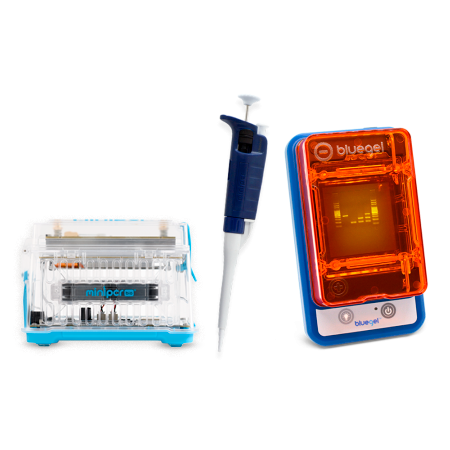
- 25 chances to win a miniPCR bio DNA Discovery System, including a miniPCR® thermal cycler and a blueGel™ electrophoresis system!
25 Awards per contest cycle
- 5 Finalist Awards (Learn more)
- 5 Junior Scientist Awards (Learn more)
- 5 Constellation Awards (Learn more)
- 10 Honorable Mentions (Learn more)
The winning experiment is launched to the ISS! (Learn more)
We celebrate all of these values
- Creativity and innovation – meet our past winners
- Youth Engagement – learn about our Junior Scientist Awards
- Class participation – read about our Constellation Awards
- Mentorship – meet the Genes in Space mentors
TIMELINE


FAQ
You must submit your experimental idea online on or before April 10, 2026 at 11:59 pm PDT.
Students in grades 7–12 who attend a U.S. public, private, or home school are eligible to participate in Genes in Space. Applicants must be enrolled to study within the U.S. or in U.S. territories.
No. Your submission will be judged on creative and scientific merit of your idea. If selected as the winner, you will attend Space Biology Camp to prepare your experiment for space travel.
Not necessarily! You may use any tool in the Genes in Space Toolkit - alone or together. However, access to these tools or prior knowledge of how to use them is not required.
For the purposes of your proposal, yes. Your Genes in Space proposal may include any tool that is necessary for your experiment. For example, many prior Genes in Space experiments have involved analysis by gel electrophoresis after samples have been returned to Earth. Genes in Space-6 incorporated CRISPR and direct DNA sequencing of samples amplified on-orbit. Genes in Space winners will work alongside their mentors, astronauts, and space biologists to push the boundaries of DNA analysis in space!
Finalists’ schools will be awarded a complete DNA Discovery System. Each kit includes a miniPCR thermal cycler, a blueGel™ electrophoresis system, and a 20 µl micropipette- a $950 value
Yes! The winning experimental design will be conducted aboard the International Space Station, pending approval from The ISS National Laboratory. The exact launch date will be determined after winners are announced.
miniPCR is a conventional (end point) PCR thermal cycler. However, you can propose an experiment that uses quantitative PCR (also referred to as real-time PCR or qPCR). It won’t affect your chances of winning the competition.
AI tools may not be used for idea generation or writing content, but there are acceptable uses of this technology. Continue here to read our framework for how A.I. tools can be used responsibly in our competition.
2026 finalists will present their ideas July 28-30 to contest judges at Countdown to Discovery in Houston, TX.
No, not to the same Genes in Space contest. We can only accept one proposal per student per contest year. However you are welcome to participate in Genes in Space every year that you are eligible. That means you can submit your best idea this year and save your other ideas to submit in future years.
Unfortunately no, the current Genes in Space contest is only open to students in 7-12th grade who live on United States soil (US States and territories). In 2016 we offered a contest in the United Arab Emirates and hope to offer more international contests in the future.
Absolutely! In fact, our 2018 winning team was made up of students from different high schools.
Yes! We welcome submissions from homeschooled students.
You can email us at genesinspace@minipcr.com.