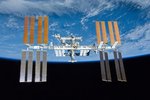
Genes in Space launches student-designed biomanufacturing experiment to the International Space Station
- 2025 contest winner Nitya Johar’s experiment will further our understanding of how proteins are made in space.
Kennedy Space Center, FL, October 13, 2026 – Today, an idea that Nitya Johar had as a high school student launched aboard the SpaceX CRS-35 resupply mission to the International Space Station. Johar won the 2025 Genes in Space contest, and now her experiment is on its way to being performed by astronauts.
Johar’s experiment addresses a key biological challenge of spaceflight: producing proteins efficiently. On Earth, industry biomanufactures proteins for many applications, including medicines, industrial enzymes, and biofuels. Making proteins on demand could also help astronauts on long-duration missions, but optimizing the process for the unique conditions of space remains an unexplored challenge.
DNA encodes the instructions for making proteins. But just as some words can be spelled in slightly different ways (i.e., gray and grey), different genetic sequences can encode the same protein. Johar’s experiment will test whether these alternative genetic “spellings” affect how efficiently cells produce the protein.
Johar’s experiment will use slightly different genetic sequences that encode the same fluorescent protein. As the proteins are produced aboard the International Space Station, tools developed by miniPCR bio will allow astronauts to monitor protein production in real time by measuring how brightly the protein samples glow. The data will be transmitted to Earth to determine whether different genetic “spellings” affect protein production in space.
"The idea of launching something to space itself is just so amazing that I have no words for it. Looking back on this experience over the past year, I’ve been thinking about how awesome it is that the program allowed me to take something that was such a small idea in the back of my mind and turn it into something that we can actually send to space," said Johar following the launch. "
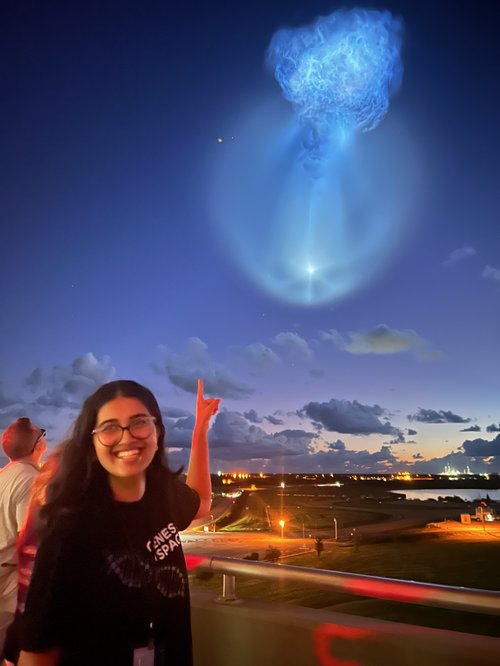
I think also space is really cool because it gives you the opportunity to connect with so many people, it just universally inspires so much awe and wonder and it has been so amazing to connect with people over it, I can’t wait to see what’s in the the future for this experiment and the rest of the Genes in Space program.”
Johar won the Genes in Space contest as a junior at Skyline High School in Sammamish, Washington. Her academic sponsor, Steve Gillispie, and her Genes in Space Mentor, MIT PhD student Marissa Morales, supported her proposal. She has continued her scientific journey at Case Western Reserve University, where she is studying biochemistry. The experimental design and protocols were developed with guidance from Dr. Ally Huang at miniPCR bio and Dr. Evan Kalb, a postdoctoral fellow at the University of Minnesota working in the laboratory of Dr. Kate Adamala.
About Genes in Space™
Genes in Space is a national STEM contest that challenges students in grades 7 through 12 to design biotechnology experiments using the ISS National Lab, a platform for cutting-edge research that enables future space exploration. The contest is a collaboration between miniPCR bio™ and The Boeing Company, with support from the ISS National Laboratory and New England Biolabs®.
Learn more at www.genesinspace.org.
Media contacts:
miniPCR bio: Kristin Hennessy-McDonald, genesinspace@minipcr.com, +1 (781) 990-8727
Boeing: Rosa Bañuelos, rosa.i.banuelos@boeing.com, +1 (321) 313-3134