
The Teacher’s Launchpad: How Genes in Space Transforms the Life Sciences Classroom
In my 12 years as a life sciences and biotechnology educator, I searched for ways to engage students in real-world scientific problem solving. I loved using the Genes in Space Contest, which challenges U.S. students in grades 7-12 to design experiments in space biology to be tested aboard the International Space Station. Each year, one winning idea is launched to the ISS for astronauts to perform!
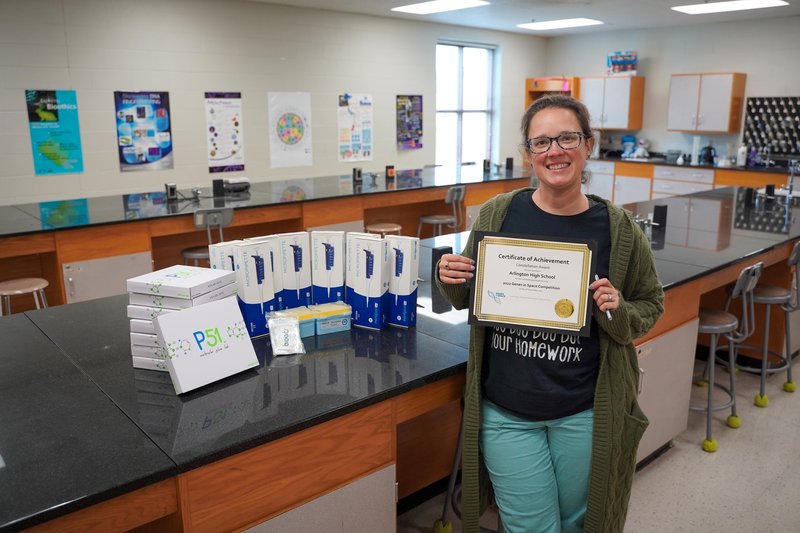
Here are two reasons why I used the Genes in Space Contest in my life science classroom:
Foster student engagement
- Using space biology as an anchor phenomenon to investigate biological concepts sparks student curiosity!
- Because students select their own research focus, the Genes in Space contest lets them explore topics that interest them personally. For example, a student interested in sports can explore how to maintain muscle mass in space.
Connect science standards with critical thinking about real-world problems
- The structure of DNA, mutations, and gene expression are all core concepts in any biology course, and these topics are relevant to many unanswered questions in space biology.
- Students practice critical thinking skills needed to tackle complex real-world problems, such as “How do we grow enough food in space for long-term missions?” or “How can we prevent bone loss from microgravity?”
For suggestions on implementing Genes in Space, see our Teacher Resources or watch our webinar from two teachers who implemented Genes in Space in their classrooms.
If you’d like to learn more about the Genes in Space Contest, you can also sign up for a Microbe Hunters Virtual Workshop.