Educators learn hands-on space biotechnology at the Challenger Center Conference
This year marks a monumental milestone: the 40th Anniversary of Challenger Center, honoring the legacy of the Space Shuttle Challenger STS-51L crew. To celebrate four decades of inspiring young explorers, team members from Challenger Centers across the country gathered at the Christa McAuliffe Center at Framingham State University for the Annual Challenger Center Conference.
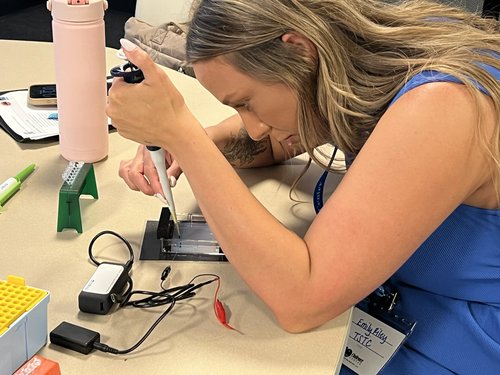
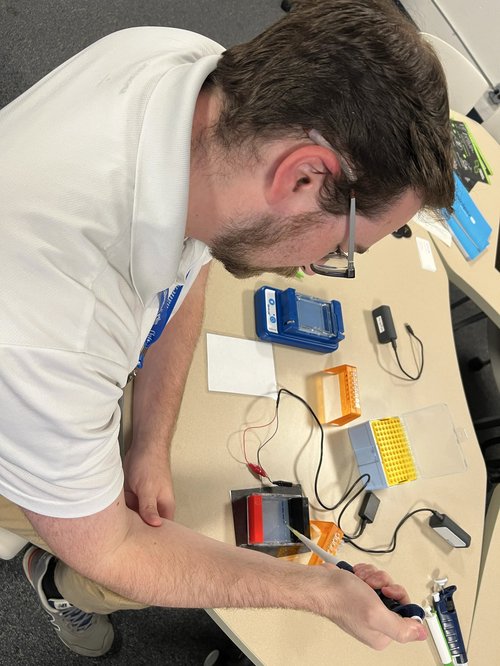
Genes in Space hosted two interactive, hands-on workshops where conference participants, who manage Challenger Centers across the country, ran the Microbe Hunters Gel Electrophoresis Lab, learned how molecular biology techniques could solve science problems in space, and learned how to integrate this activity into their own Challenger Learning Center and/or local teacher training initiatives.
“Many of the workshop participants had never run gel electrophoresis or even used a micropipette before,” says Dr. Ally Huang, the Genes in Space Science Lead, who facilitated the workshops. “But everyone was so excited and focused on learning, and since the activity is designed for biotech beginners, everyone got great results and could imagine running this activity at their Challenger Centers.”
When science education is rooted in real-world application, learning changes instantly. When that real-world application connects students to space travel, it changes their entire educational experience.
The Challenger Space Shuttle crew believed in the power of curiosity, education, and discovery. Four decades later, pairing Genes in Space with the national network of Challenger Centers honors that memory by giving young people the tools to do real, groundbreaking science.