
OUR STORY
Genes in SpaceTM started in 2015 as a collaboration between Boeing and miniPCR bio with the goal of inspiring young minds to solve real-world problems in the biological and physical sciences. Since then, generous sponsors including the ISS National Laboratory and New England Biolabs have joined us to support this unique program.
We’ve now received thousands of inspiring, student-led proposals, and our alumni have enabled outstanding space biology milestones. We celebrate creativity, collaboration, and critical thinking among young innovators by renewing the challenge every year. Thank you for joining us in this exciting journey!
GENES IN SPACE FOUNDING PARTNERS

Boeing, as NASA’s prime contractor for the International Space Station (ISS), provides research integration, sustaining operations and maintenance for the utilization of the station. The ISS, a U.S. National Laboratory, offers a unique, microgravity environment that enables scientific research to benefit mankind.
Space-tested miniPCR™ technology powers DNA analysis aboard the International Space Station. miniPCR™ is equally accessible to your lab and classroom. Learn more about our technology, software, and educational curriculum at www.minipcr.com
GENES IN SPACE SPONSORS

In 2005, Congress designated the U.S. portion of the ISS as the nation’s newest national laboratory to optimize its use for improving quality of life on Earth and advancing science, technology, engineering, and mathematics (STEM) education. The ISS National Lab manages access to the permanent microgravity research environment, a powerful vantage point in low Earth orbit, and the extreme and varied conditions of space.

Established in the mid 1970's, New England Biolabs®, Inc. (NEB®) is the industry leader in the discovery and production of enzymes for molecular biology applications and now offers the largest selection of recombinant and native enzymes for genomic research. For nearly 50 years, NEB® has been committed to the advancement of science and science education. For more information on our products and corporate initiatives, please visit www.neb.com
LEADERSHIP TEAM
Scott Copeland
Co-founder of Genes in Space, Boeing
Kevin Foley
Co-founder of Genes in Space, Boeing
Ezequiel (Zeke) Alvarez Saavedra, PhD
Co-founder of Genes in Space, miniPCR bio
Sebastian Kraves, PhD
Co-founder of Genes in Space, miniPCR bio
Ally Huang, PhD
Lead Research Scientist, miniPCR bio
Kristin Hennessy-McDonald, PhD
Program Lead
THE ROLE OF A MENTOR
Each year, when we name 5 Finalists to advance in the competition, we ask those students to prepare an oral presentation on their project and pitch it to our contest judges. But we don’t ask them to do it alone. We connect them with a mentor whom they work with to refine their scientific plan and develop a standout pitch.
Our mentors are scientific researchers who carve time out of their own busy lab schedules to help their mentees develop as young scientists. Their involvement year after year is a huge part of what makes our program a success.
In 2020 we established the John Hatch Memorial Prize in Mentorship to recognize our outstanding mentors. The Prize is named for Harvard University PhD candidate and veteran mentor John Hatch (2nd from right) who tragically passed away in 2019.
The Prize comes with a stipend and includes the honor of judging the Genes in Space competition. It was established by the Hatch family with additional support from New England Biolabs. Meet past recipients below.
Past Hatch Prize Recipients

Dr. Holly Christensen
2020 Hatch Prize Recipient
Alma mater: Massachusetts Institute of Technology
Research: Sex cell development
Served Genes in Space competitions: 2015, 2016, 2017, 2018
Connect with Holly:
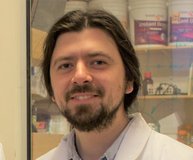
Dr. Kutay Deniz Atabay
2021 Hatch Prize Recipient
Alma mater: Massachusetts Institute of Technology
Research: Regeneration in the nervous system
Served Genes in Space competitions: 2015, 2016, 2017, 2018, 2019
Connect with Deniz:

Dr. Matt Smith
2022 Hatch Prize Recipient
Alma mater: Harvard University
Served Genes in Space competitions: 2018, 2019
Connect with Matt:

Dr. Bess Miller
2023 Hatch Prize Recipient
Alma mater: Harvard University
Served in Genes in Space Competitions: 2018, 2019, 2021, 2022
Connect with Bess:

2024 Hatch Prize Recipient
Alma mater: Harvard University
Served in Genes in Space Competitions: 2020, 2021, 2022
Connect with Ana Karla:
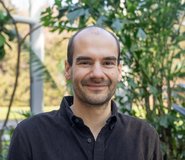
2025 Hatch Prize Recipient
Alma mater: Harvard University
Served in Genes in Space Competitions: 2020, 2021, 2022, 2023, 2024
Connect with Aleks

2026 Hatch Prize Recipient
Alma mater: Harvard University
Served in Genes in Space Competitions: 2021, 2022, 2023, 2024
Connect with Kayleigh
Meet John Hatch
PAST WINNERS
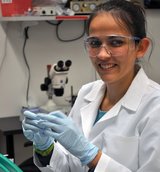
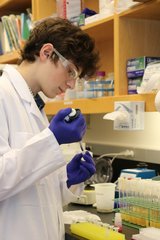
Anna-Sophia Boguraev
Fox Lane High School, NY
Current position: MD/PhD student at Harvard University/Massachusetts Institute of Technology
Project: To test the effect of cosmic radiation and microgravity on the immune system
Launched to space: April 2016
Published in NPJ Microgravity in 2017
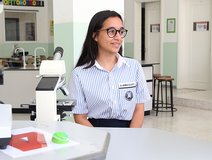
Julian Rubinfien
Stuyvesant High School, NY
Current position: undergraduate student at Yale University
Project: To measure the length of telomeres in space
Launched to space: April 2017
Published in FASEB BioAdvances in 2019
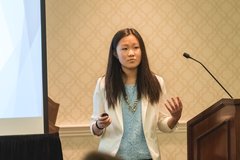
Alia Al Mansoori
Al Mawakeb School, Dubai
Current position: undergraduate student at the University of Edinburgh
Project: To study gene expression changes in space that might help protect astronauts from unwanted cell death
Launched to space: August 2017
Published in PLoS One in 2018
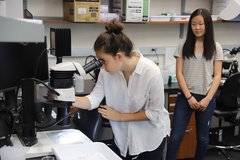
Sophia Chen
Lakeside High School, WA
Current position: undergraduate student at Princeton University
Project: To measure cancer-inducing genomic instability in astronauts
Launched to space: April 2018
Liza Reizis
Stuyvesant High School, NY
Current position: undergraduate student at New York University
Project: To assess the effects of microgravity on the differentiation of immune system cells
Launched to space: April 2018
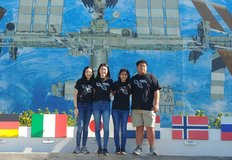
Rebecca Li, Michelle Sung, Aarthi Vijayakumar & David Li
Mounds View High School, MN (Rebecca, Michelle, and Aarthi), Woodbury High School, MN (David)
Current positions: undergraduate students at Yale University (Rebecca & Aarthi), Johns Hopkins (Michelle), and Massachusetts Institute of Technology (David)
Project: To use CRISPR/Cas9 genome editing as a tool to investigate double-strand break repair in microgravity
Launched to space: May 2019
Published in PLOS One in 2021
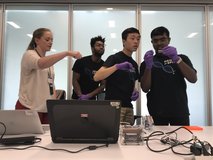
Finsam Samson & Yujie Wang
Troy High School, MI
Current positions: undergraduate students at Stanford University (Finsam) and UC Berkeley (Yujie)
Project: To study how spaceflight affects the expression of genes involved in neural function
Launched to space: November 2020
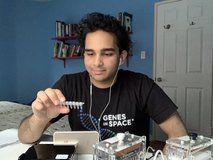
Kristoff Misquitta
Stuyvesant High School, NY
Current position: undergraduate student at Massachusetts Institute of Technology
Project: To probe the basis of spaceflight-induced changes in drug metabolism
Launched to space: August 2021
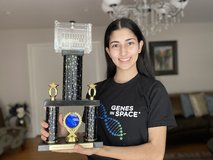
Selin Kocalar
Leigh High School, CA
Current position: undergraduate student at Massachusetts Institute of Technology
Project: To develop a biosensor to test for water contamination aboard spacecraft
Launched to space: July 2022
Published in ACS Synthetic Biology in 2024
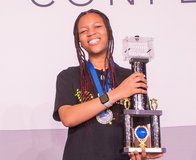
Pristine Onuoha
East Chapel Hill High School, NC
Project: To understand the basis for telomere lengthening observed in space travelers
Launched to space: June 2023
Published in Gravitational and Space Research in 2026

Isabel Jiang
Crystal Springs Uplands School, CA
Current Position: Attending Yale University
Project: Detection and Treatment of LINE1 Retrotransposon Activation in Space
Launched to space: September 2024
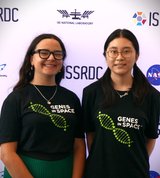
Isabelle Chuang & Julia Gross
The Nightingale-Bamford School, NY
Project: Real-time Tracking of Microgravity-Induced Effects on Phage-Host Interactions Using Fluorescence
Launched to space: August 21st, 2025!

Nitya Johar
Skyline High School in Sammamish, WA
Project: Lost in Translation: How Microgravity Could be Confusing your DNA's Language
Launching to space: 2026
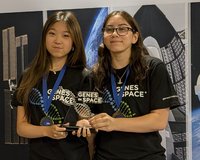
Chloe Comisarow and Serena Tsao
Bronx High School of Science in Bronx, NY
Project: Stress-induced kidney stone risk due to microbiome dysregulation in astronauts
Launching to space: 2027